
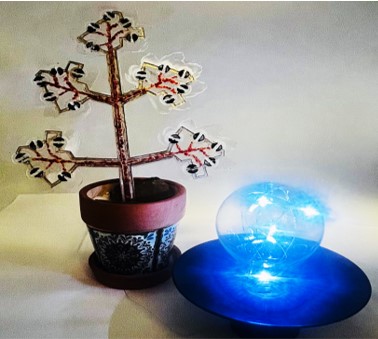
Carbon dioxide (CO2) concentrations are often much greater indoors than outdoors, creating a significant health concern in urban environments where people spend more than 80 percent of their time inside homes, offices, and other buildings.
Traditional CO2 mitigation techniques become increasingly impractical as outdoor CO2 levels continue to rise with global warming. This work demonstrates innovative cyanobacterial artificial plants designed for enhanced indoor carbon capture together with direct utilization of captured CO2 to produce oxygen (O2) and enough bioelectricity to power portable electronics.
The artificial plants use indoor light to stimulate cyanobacterial photosynthesis, effectively reducing indoor CO2 from 5000 ppm to 500 ppm. That corresponds to a 90 percent reduction, substantially greater than the approximately 10 percent reduction observed from natural plants alone.
At the same time, the system produces oxygen and bioelectricity, offering an energy-efficient route to make practical use of captured CO2. Each artificial leaf contains five biological solar cells that generate electricity during photosynthesis. Water and nutrients are delivered to each cell through transpiration and capillary action, mimicking natural plant systems.
The artificial plant produces an open-circuit voltage of 2.7 V and a maximum power of 140 µW, sufficient to operate portable electronics. Overall, this approach presents a decentralized strategy for improving indoor air quality while generating electricity, providing a sustainable response to indoor environmental challenges under rising global CO2 levels.
← Back to Research